MNC full form is Multi-national Corporation. MNC refers to a large corporate organization which operates its business activities in more than one nation, other than its native country.
This blog topic covers types of MNC’s,their examples and benefits. MNC’s play a huge role as they can manage the entire distribution, production, and marketing process in several countries. Let us roll out this topic with the understanding of What is MNC.
What is an MNC – Multi-National Corporation?
Multinational Corporation (MNC) refers to those corporations that controls and manages offices, factories, and facilities or assets in at least two or more countries. They are also widely known as Transnational Corporations (TNC’s) or multinational enterprises, or even “stateless corporations”.
Subsequently, the main feature that characterizes them is that they function in more than one country and can direct and coordinate significant activities of their business.
The MNC headquarters are generally based in one country. But its branches operate in other nations, under the directions of the head office.
MNCs outshine regional markets, boost up the local employment market, and play a remarkable role in cross-border trade and investments.
MNC vs Domestic Company – Key Differences
| Key Aspect | Multinational Company (MNC) | Domestic Company |
| Business Presence | Operates in multiple countries with global offices and markets. | Operates mainly within a single country. |
| Market Reach | Serves international customers and expands across global markets. | Primarily focuses on local or national customers. |
| Capital Investment | Has access to larger financial resources and foreign investments. | Relies on domestic funding and local investors. |
| Technology and Innovation | Invests deeply in advanced technology, automation, and R&D. | Technology adoption relies on company size & budget. |
| Employment Prospects | Creates jobs across multiple countries with global career opportunities. | Generates employment mainly within the home country. |
| Training and Skill Development | Offers planned training, global exposure, and international best practices. | Training is generally focused on local business needs. |
| Salary & Benefits | Mostly gives competitive salaries, global benefits, and performance incentives. | Salary and benefits differ based on company size and industry. |
| Decision-Making | Decisions are often made at the global headquarters and implemented locally. | Decisions are usually quicker and taken within the country. |
| Business Flexibility | May have slower decision-making due to multiple approval levels. | Agile in replying to the local market changes. |
| Customer Understanding | Adapts products for various countries but follows global standards. | Has a detailed understanding of local customer preferences and culture. |
| Supply Chain | Operates a global supply chain with international sourcing. | Depends on domestic suppliers and logistics. |
| Brand Recognition | Enjoys powerful global brand recognition and customer trust. | Brand awareness is usually limited to the domestic market. |
| Competition | Competes with international companies worldwide. | Primarily competes with other domestic businesses. |
| Economic Contribution | Brings foreign investment, technology transfer, and export rise. | Supports local entrepreneurship, SMEs, and regional economic development. |
| Risk Exposure | Faces risks from global economic changes, currency fluctuations, and geopolitical events. | Mainly affected by domestic economic and regulatory conditions. |
| Regulatory Compliance | Must comply laws and regulations across multiple countries. | Needs to follow national and local regulations. |
| Career Growth | Offers international mobility and overseas career opportunities. | Career growth is usually within domestic operations. |
| Examples | Microsoft, Google, Toyota, Nestlé, Samsung | Tata Group, Reliance Industries, Amul, Patanjali, Dabur (primarily domestic operations in context) |
Key Features of an MNC Company
1. Production and Marketing Spread Across Multiple Countries
The defining trait of any MNC company is its geographic footprint. Rather than relying on one factory or one target market, these businesses set up production units, R&D labs, and marketing teams in multiple countries simultaneously.
This allows them economically source for raw materials in one place, skilled labour in another, and be physically close to customers everywhere. A product might be engineered in a country, made in other, and marketed with a completely different strategy depending on where it’s sold.
2. Massive Financial Resources and Turnover
MNCs typically produce revenues which may run a small country’s whole economy. This isn’t an accident. Operating in many markets means various revenue streams, so a downfall in some region rarely put down the whole business.
This financial cushioning also means MNCs may absorb short-term losses, fund long-term research, and outlast small local competitors during tough economic periods.
3. Growth Through Mergers and Acquisitions
Rather than rising slowly and organically, most MNC companies grow fast by acquiring or merging with other businesses. Sometimes rivals, sometimes top-quality suppliers, sometimes companies from entirely different industries.
This strategy gives them instant access for new markets, established customer bases, and ready-made distribution networks propelling their economic power far quicker than building from scratch ever could.
4. Heavy Use of Capital-Intensive, Advanced Technology
Sustaining the global race in the long run needs serious investment in technology. Automated manufacturing, AI-powered supply chains, and Proprietary systems that small firms simply can’t afford. This technology-driven approach helps MNCs scale up their production quickly while keeping quality consistent across each country they operate in.
5. Big Spending on Advertising and Global Brand Building
A strong global reputation doesn’t happen by accident. MNCs invest heavily in advertising and PR to build brand recognition feeling consistent whether you’re in London or Mumbai. This isn’t just about selling more. It’s about creating a trusted global identity that customers promptly recognize.
Types of Multi-National Corporations
MNCs can be categorized based on their growth, goals, and management structures as per given below:
- International Division Structure: MNCs fragment international and domestic businesses, allowing managers flexible decision-making in international markets.
2. Global Centralized Structure: Headquarters are in the home country; all worldwide activities are controlled by this central base.
3. Decentralized Structure: Operations are handled independently at each country level, each one having its own management structure.
4. Parent-subjective Structure: The parent company directs & controls business strategies of subsidiaries in various countries.
How Does an MNC Work?
An MNC starts life in one home base country, where the head office sets the big strategy. Which kind of markets to enter, how much to invest, and what the brand must stand for. From there, it opens subsidiaries in other countries to cater local production, sales, or service, while still following direction from headquarters. Some decisions stay intact and fully controlled from the top; others get handed to local teams who know their market best.
Behind the scenes, an MNC mainly designs a product inside a country, manufactures it in the other country, where costs make sense, and sells it in a third country market i.e. market of that product, moving profits, technology, and know-how across all of them. Still, no matter how many borders it crosses, it works hard to keep one thing consistent everywhere. The brand experience customers identify whether they’re in Tokyo or London.
Best MNC’s in the World I Top 10 MNC’s Worldwide
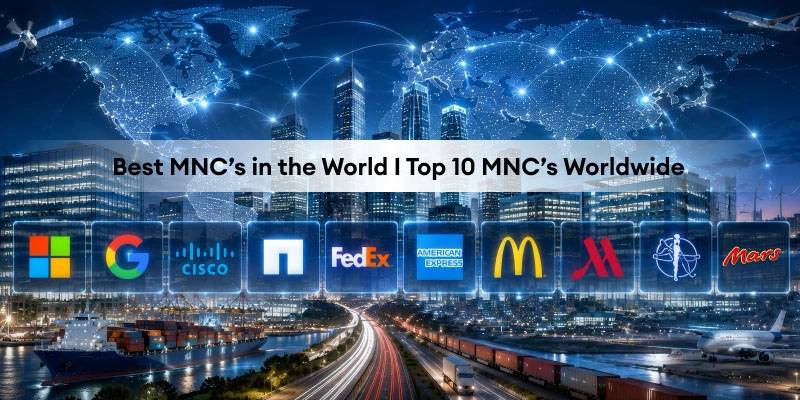
Find here the MNC company list across the world:
1. Microsoft:
It’s a top leading Multinational Company founded in 1975 by Bill Gates and Paul Allen. This Information technology company develops consumer electronics, personal computers, computer software, and other allied services. Many countries including the US, the UK, the UAE, Italy, Mexico, Poland, Denmark, Chile, Argentina, Brazil, Canada, Ireland, India, Germany, Belgium, Norway, Sweden, Spain, etc. Ensure that Microsoft is a nice, decent workplace. Microsoft is an MNC to work globally.
2. Google:
Google is a most powerful Corporations in the World; Google LLC is a multinational company in technology. This American MNC offers internet-related products and services such as a search engine, cloud computing, online advertising technologies, hardware, and software. Its services are Google Docs, Google Sheets, Google Allo, Google Slides, Hangouts, etc. Google was established in 1998 by Larry Page & Sergey Brin. YouTube, YouTube TV, Google AdMob, Fitbit, Waymo, Kaggle, etc. are Google’s subsidiaries.
3. Cisco:
Cisco Systems is a Multinational Networking and Hardware Corporation started by Sandy Lerner and Leonard Bosack in 1984. It makes, develops, and markets telecommunications equipment, networking hardware devices & their software, with other technology products & services. Cisco is USA-based, with headquarters in San Jose, California. Cisco Webex, Thousand Eyes, Jabber Inc., AppDynamics, OpenDNS, Cisco Meraki, vIPtela Inc., Duo Security Inc., imimobile, etc. are all Cisco subsidiaries.
4. NetApp:
Its ranking in the Fortune 500 list since 2012, NetApp is an American Multinational company offering data management and hybrid cloud data services. This company is founded by James Lau, Michael Malcolm, and David Hitz in 1992. NetApp has its headquarters in Sunnyvale, California in the U.S. Its subsidiaries are SolidFire LLC, Cloud Jumper Corporation, Spotinst LTD., etc.
5. FedEx Corporation:
FedEx Corporation is an USA-based multinational company giving delivery services worldwide. FedEX Corp. was established by Frederick W. Smith in May 1971. This MNC has headquartered in Memphis, Tennessee in the United States. TNT Express, FedEx Office, FedEx Express, FedEx Ground, FedEx Supply Chain, Asia Airfreight Terminal, ShopRunner Inc., are subsidiaries of FedEx.
6. American Express: American Express is a multinational corporation offering financial services. The company started by William Fargo, John Butterfield, and Henry Wells in 1850. It headquarters is in Manhattan, New York, in The United States. The American Express Company Subsidiaries are ViacomCBS Domestic Media Networks, Amex (Middle East) B.S.C., National Express Co Inc., Revolution Money, Ketera Technologies, etc.
7. McDonald’s:
McDonald’s Corporation is a multinational fast-food making company. It was founded as a restaurant by Richard & Maurice McDonald in 1940. It is having about 37,000+ outlets across the globe, serving nearly 70 million customers in 100 countries. McDonald’s employs 1.7 million + employees and Norway, Switzerland, Peru, Uruguay, Netherlands, Mexico, Denmark, Ireland, France, Colombia, Belgium, Argentina, Brazil, etc. countries consider it a good place to work at.
8.Marriott:
Marriott International Inc. is a multinational corporation setup by J. Willard Marriott & Alice Marriot in 1927. This is U.S.A. based MNC with headquarters in Bethesda, Maryland. Marriott operates, licenses, and franchises lodging of residential & timeshare properties. Marriott’s portfolio of subsidiary brands having names like St. Regis Hotels, Aloft Hotels, Le Méridien, Westin Hotels & Resorts, Starwood, Sheraton Hotels & Resorts, Gaylord Hotels, AC Hotels, Ritz-Carlton Hotel Company, and several others under its ownership.
9. Medtronic: Medtronic is a Multinational Company leading in medical technology, solutions, and services. They offer solutions for the highest healthcare challenges worldwide. They manufacture and market medical devices and therapies. It was initiated by Earl Bakken and Palmer Hermundslie in 1949 and has its headquarters in Dublin, Ireland. Its subsidiaries are Mazor Robotics, Given Imaging, Companion Medical Inc., TyRx Pharma Inc., RF Surgical Systems, Medtronic Sofamor Danek Inc., Medtronic Spine LLC, Puritan Bennett, Titan Spine Inc., HeartWare Inc., etc.
10. Mars: This is one of the trending Multinational Companies in the world today. They are manufacturers of chocolates, mints, fruity confectionery, chewing gums, pet food, & other products; they even offer animal care services. This company is started by Franklin Clarence Mars in 1911 and has headquarters in McLean, Virginia. As per Forbes, it is the 6th largest privately held company in the U.S. Its subsidiaries are Wrigley Company, Pedigree Petfoods, Royal Canin, Banfield Pet Hospital, Seeds of Change, Nutro Products, VCA Animal Hospitals, Mars Japan Limited, etc.
Top MNC Companies in India
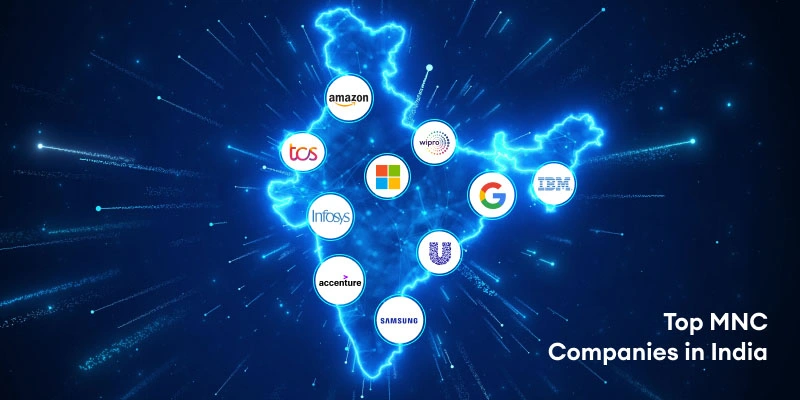
1.TCS – Tata Consultancy Services
This company started in 1968 and headquartered in Mumbai, is considered India’s topmost MNC by revenue, employee count, and international market presence according to various 2026 industry assessments. The company creates FY2026 revenues over USD 30 billion, employs more than 600,000 globally working professionals, and operates across 150 countries. This makes the company, one of the most globally distributed companies of Indian base.
TCS serves Fortune 500 enterprises worldwide across BFSI, healthcare, retail, manufacturing, and government with end-to-end technology, consulting, and AI transformation services, and its extraordinary global reach, consistent profitability, and anchor role in the Indian economy make it the most important contributor in the Indian corporate arena.
2. Infosys Limited
Infosys, This India based Information Technology company started in 1981 by Narayana Murthy and six co-founders and headquartered in Bengaluru. It is India’s second largest MNC by revenue and the most growth-driven large-cap IT company now.
The company’s Topaz AI platform has been used by more than 150 global clients. It serves 1,700 clients in 50 countries. Infosys is an Indian MNC with the most prominent global brand recognition other than the Tata Group.
Infosys caters large global companies across BFSI, manufacturing, retail, healthcare, and communications with AI-driven digital transformation and consulting services and is the most internationalised pure-play technology MNC from India with a specific strong presence across North America, Europe, and Australia.
3. Microsoft India
Microsoft Corporation is operating in India since the year 1990, a most strategically committed American MNCs in India. Microsoft India employs more than 18,000 professionals and its Azure cloud, Office 365, Teams, LinkedIn, and GitHub platforms serve millions of Indian businesses and government customers. Microsoft India’s Development Centre in Hyderabad is one of the biggest Microsoft R&D hubs outside the America.
Microsoft India serves enterprise customers, government institutions, developers, startups, and individual consumers with its complete portfolio of cloud, productivity, collaboration, and AI solutions, and its USD 3 billion infrastructure investment makes it one of the most committed MNCs to India’s digital transformation objective.
4. Amazon India
Amazon India, began in 2013 as an Indian subsidiary of Amazon.com Inc. has more than USD 26 billion invested in India across e-commerce, Amazon Web Services, cloud infrastructure, digital payments, and logistics. The company serves to millions of Indian customers via Amazon.in with its Prime membership program. Also, its AWS cloud division is a pioneer technology provider for India’s startups, enterprises, and government digital initiatives.
Amazon India serves consumers, sellers, businesses, and enterprises across India by its e-commerce marketplace, Prime Video content service, AWS cloud platform and logistics infrastructure. It is the biggest employer of technology and logistics warehouse for the big Indian job seekers. It has a remarkable impact on Indian economy by an MNC.
5. Accenture India
Accenture, a global technology driven services company began in 2001 as a professional successor to Andersen Consulting, functions as one of its largest global delivery centres in India with more than 300,000 employees in the country, making India its largest ever employee base globally.
The company gives strategy, consulting, technology, and operational services to clients from all industries and has been on the verge of deploying generative AI solutions across its Indian and global client networks. Accenture’s India operations are centrally based to its global service delivery model.
Accenture India attains global business clients across every industry with management consulting, digital transformation, cloud migration, and AI-based services, and its special workforce in India with more than 300,000 professionals making it one of the single largest corporate sector employers in the country.
6. Hindustan Unilever Limited (HUL)
Hindustan Unilever Limited, is an Indian subsidiary of the Anglo-Dutch multinational Unilever plc started in India in 1933. It is the archetypal FMCG MNC with the in-depth market penetration in India. The company employs more than 21,000 professionals in India, and its products reach out to the tiniest villages via a largely scattered network of 9 million retail outlets. HUL’s 50-brand portfolio covering personal care, home care, and nutrition is present in almost every Indian household with variable income level.
HUL serves each Indian household across income levels and geographies with its market-leading consumer brands and is the benchmark for consumer goods distribution excellence in India for the decades across a strong competition inside.
7. Samsung India Electronics
Samsung Electronics, the South Korean multinational entered India in 1995. It has come up as the strongest consumer electronics and smartphone brands in India with a big manufacturing facility in Noida.
It is one of the largest mobile manufacturing setups worldwide. Samsung has its India operations covering smartphones, televisions, home appliances, and semiconductor components. Samsung is the leading premium Android smartphone brand in India and its Noida plant takes care for both domestic as well as export markets.
8. Google India (Alphabet Inc.)
Google India, the Indian subsidiary of Alphabet Inc. established in 1998, operates one of the most powerful technology platforms in the country. Google’s products are Search, Maps, YouTube, Gmail, Google Pay, and Android have become basic digital infrastructure for India, with its offices in Hyderabad, Bengaluru, Gurugram, and Mumbai. It has the largest engineering workforces outside the US.
Google India serves individual consumers, businesses, developers, and government institutions with its complete digital product ecosystem and is the dominant platform for online search, digital advertising, video content, and mobile operating systems across India’s fastest growing digital economy of 900 million net users.
9. Wipro Limited
Wipro Limited, setup in the year 1945 by M.H. Hasham Premji and now led by Thierry Delaporte, has travelled from a vegetable oil company into a global IT services multinational with global level operations across 65 countries. Wipro is classified as an Indian multinational with global delivery expertise and a remarkable international revenue base over 80 percent from outside India.
Wipro serves global businesses across BFSI, consumer, energy, manufacturing, technology, and healthcare with AI-based technology services and consulting, and its changeover under current leadership adding its approved Rs 150 billion buyback in April 2026 shows a company which is returning capital and investing in its upcoming growth cycle.
10. IBM India
IBM Corporation, incorporated in 1911 and is operating in India over 70 years now, employs around 1,00,000 Indian professionals making it one of the top-class American employers in the country. IBM India carries some of IBM’s largest research and development facilities outside America and is a centralised resource to the company’s global delivery network of AI-driven business solutions via its Watson platform.
IBM’s India operations cover technology services, consulting, research, mainframe and cloud infrastructure, and the company has been one of the largest-serving and most consistently available MNCs in India.
IBM India caters large businesses and government institutions across India and offers global delivery support for IBM’s worldwide client base in technology services, AI consulting, cloud migration, and business automation, making it one of the most embedded and strategically vital MNC technology operations in the complete Asia Pacific region.
Advantages of MNCs
1.Generate employment opportunities in host countries
Create jobs across many different sectors, helping to improve livelihoods of citizens and empower the local economy. MNCs create employment opportunities for skilled, semi-skilled, and entry-level professionals in every country-they reach. They also contribute to workforce development by conducting professional training and career growth opportunities. This helps to improve living standards of the local people while empowerment of the local job market.
2.Attract inflow of capital, aiding rapid development in the host nation
Bring foreign investment supporting business expansion, its infrastructure, and overall economic growth. Foreign investment from MNCs helps businesses to expand their operations and increase production capacity. It also supports the overall development of modern infrastructure and attracts additional investors regularly. As a result, the host economy becomes more competitive and resilient.
Increase exports by multiplying production, helping the country to earn more foreign exchange for years. Many MNCs use their global distribution networks to promote products in international markets consistently. Higher exports improve trade performance and strengthen foreign exchange reserves for the country. This contributes to a healthier balance of payments over time.
3.Introduce advanced technology and management methods
Bring latest technologies and proven business practices improving productivity and operational efficiency. Local businesses and employees often benefit from exposure to modern production techniques, skills and digital innovations. Knowledge sharing supports in the improvement of quality standards and operational processes. Over the time, these improvements cause for the scaled overall competitiveness of domestic industries.
4.Support industrial and infrastructural growth
As industries continues to grow, the practical demand for better roads, logistics support, communication facilities, and public services also increases. This inspires real investments in infrastructure beneficiary to both businesses and communities. Improved facilities support long-term economic development across regions.
Disadvantages of MNCs
1.Future threat for the survival of local and small industries due to competition
Stronger competition from large global companies can make it a crucial issue for small local businesses in the survival. Small businesses mainly struggle to match the pricing, technology, and marketing strength of multinational companies. This can drop down their market share and restrict the business growth. In some cases, local enterprises could be forced to shut down or merge with the bigger firms.
2.Tend to cater mainly to wealthy segments, potentially ignoring the needs of poor communities
Mostly focus on high-income customers, while the needs of low-income groups to receive less attention. Many MNCs design premium products and services that are more affordable for higher-income consumers. This may leave essential needs of lower-income communities less addressed. As a result, access to certain products and services can remain unequal.
3.Expand the wealth gap between rich and poor within the host country
Commercial benefits may not be equally shared, leading to a wide gap between different income groups. While MNCs make wealth and employment, the financial gains may be focussed more into specific groups. Highly skilled professionals and investors dominate low-skill working staff in the long run. This can contribute to growing income inequality over the time.
4.Can dominate or influence local economic and policy decisions
Their financial strength and market presence can sometimes supress business practices and government policies. Larger multinational companies have significant influence most of the time, because of their investment and financial contribution. Their business priorities can affect market dynamics and policy discussions. Maintaining transparent regulations helps ensure that economic growth remains fair and balanced for all stakeholders.
Impact of Foreign Direct Investment in India by MNC’s
| Economic Indicator | Latest Status / Estimated Impact |
| Total Annual FDI Inflow | US$81 Billion (FY 2024-25) – Highest in the last three years |
| Largest FDI Recipient Sector | Computer Software & Hardware (≈19% of total FDI) |
| Major Growth Drivers | IT, Automobiles, Electronics, Financial Services, Telecom |
| Employment Generation | Millions of direct and indirect jobs across manufacturing and services |
| Export Contribution | Strong contribution through IT services, automobiles, pharmaceuticals and electronics |
| Technology Transfer | AI, Cloud Computing, Automation, Digital Manufacturing and R&D |
| Infrastructure Development | Data centres, logistics parks, industrial corridors, renewable energy projects |
| Skill Development | Global training standards, innovation centres and advanced engineering capabilities |
| Tax & Economic Growth | Significant contribution via corporate taxes, GST, exports and industrial development |
Key Insights
Computer Software & Hardware attracts the largest share of Foreign Investment (19%) and is India’s top FDI sector.
Together, services and IT account for nearly a third of India’s foreign direct investment inflows.
Automobile and Electronics sectors are driving India’s manufacturing growth through Make in India and PLI.
Telecom, Renewable Energy, and Infrastructure continue to attract major investments as India grows its digital and green economy.
While exact numbers of MNCs’ contribution to GDP are not available, they continue to be major employers, exporters, and transferors of technology and a key driver of industrial growth in key sectors.
MNC Blessing or Challenge?
Multinational corporations (MNCs) serve as both a blessed asset and a challenge for economies. They attract direct foreign investments, generate job opportunities, introduce cutting-edge technologies fast, and improvise skill levels, enabling industries to expand and compete on a global level. Their existence enhances export activities and contributes to the economic advancement of many nations.
On the other side, MNCs may create substantial pressure on local enterprises due to fierce competition and might return a good portion of their earnings to their originating countries. By implementing effective industry regulations and maintaining balanced policies, nations can really reap the advantages of MNCs while protecting the interests of the local industries.
Conclusion
Knowing the MNC full form and learning what is MNC gives you a clear picture of how businesses grow and operate across international markets. A Multinational Corporation plays a significant role in today’s global economy by making jobs, bringing advanced technology, encouraging investment, and connecting countries via trade and business operations.
At the same time, it is equally important to know the challenges MNCs can create, including increased competition for local businesses, economic inequality, and environmental issues. Looking at both sides helps make a balanced understanding of their overall impact. For more information about MNC word and updates, you can email us on: sales@niyuk.ai
FAQs
What is a MNC job?
An MNC job refers to a role in a Multinational Corporation (MNC) that operates across multiple countries. These jobs mostly offer competitive salaries, global exposure, structured training, and opportunities to work with international teams. Common roles are software development, finance, marketing, customer support, engineering, and human resources.
What are the types of MNCs?
The main types of Multinational Corporations (MNCs) include decentralized corporations, global centralized corporations, international companies, and transnational enterprises. Each type varies in how it manages operations, production, and decision-making across countries while serving customers in global markets.
What are the benefits of these multinational corporations?
Multinational corporations benefit economies by bringing foreign investment, generating employment, introducing advanced technologies, and promoting innovation. They also improve infrastructure, support exports, develop workforce skills, and create opportunities for businesses to participate in global supply chains.
What is the MNC company salary?
There is no fixed salary in an MNC company, as it depends on the job role, experience, industry, and location. Freshers may earn competitive entry-level packages, while experienced professionals often receive high salaries along with benefits like bonuses, health insurance, retirement plans, and career development opportunities.